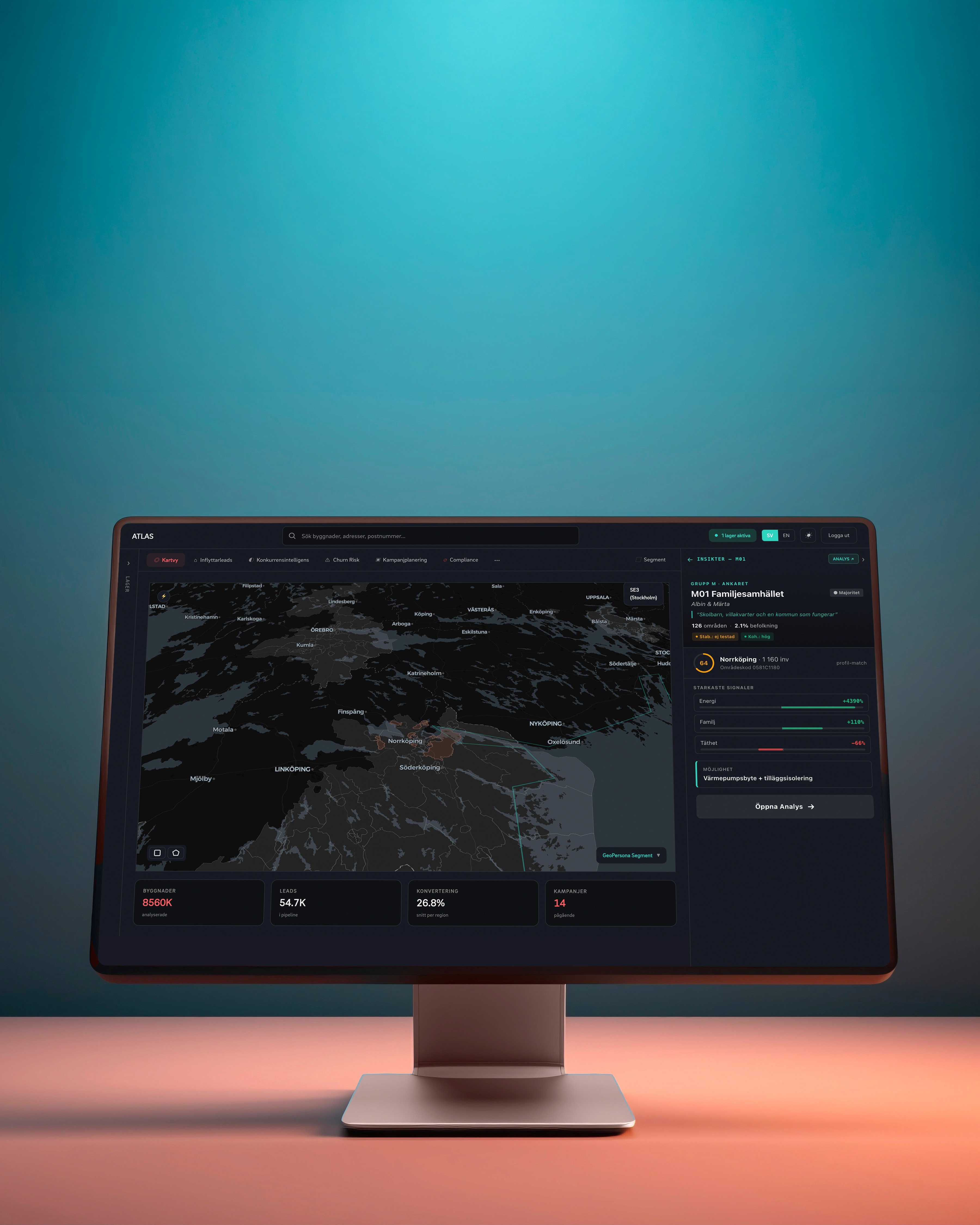
What Does 30 Days of Blindness Cost in Electricity Retail?
The electricity market doesn't reward the biggest player. It rewards the one who sees first.
Spot prices move before SCB's electricity price index updates. Customer churn starts in specific postal codes before contracts expire. A competitor drops their variable rate in SE3 - and you don't see it until next month's report.
Yet many electricity retailers still operate on delayed insight: monthly reports, quarterly reviews and historical KPIs.
The question is simple: What does 30 days of blindness cost?
The Illusion of Being Data-Driven
Many electricity retailers consider themselves data-driven. They have BI dashboards, historical spot price analysis, CRM reports on churn and compliance tracking.
But the vast majority of this insight is retrospective.
A digital maturity study for the energy sector reveals a clear divide: leading companies use real-time data and AI for faster decisions, while laggards are stuck in fragmented systems and historical reporting. This means that by the time you see increased churn or rising price risk exposure - it has already happened.
In a volatile electricity market - where the spot price in SE4 can deviate by 200% from SE1 within the same day - delay equals loss.
Scenario 1: Churn That Starts in Silence
Churn rarely happens overnight. It often begins in specific grid areas - after a local price adjustment, when a competitor launches an aggressive fixed-price contract, or during a wave of new residents who never sign up.
But if you only discover it when contracts are actually terminated, you're already 30-60 days too late.
What Does This Mean in Practice?
Consider this example: an electricity retailer with 100,000 customers and 2% monthly churn normally loses 2,000 customers per month. If a churn shift in a local segment amounts to +0.5 percentage points and is detected 30 days late, that's an additional 500 lost customers. With an average contribution margin of SEK 1,500 per customer per year, that translates to SEK 750,000 in lost annual contribution - without accounting for increased customer acquisition costs or weakened position in the area.
Industry overviews show that predictive analytics can reduce churn by up to 15%, and a case study in consumer services confirms that 10-12% churn reduction is realistic when shifting from reactive to predictive management.
The solution is about analysing each customer based on real-time signals - contract age, behavioural patterns, relocation indicators, price competition in the grid area and engagement levels - and creating a composite risk profile. Instead of discovering churn after the fact, it's about seeing which postal codes are flashing red today and acting before the customer has even started comparing alternatives.
Earlier signal means opportunity to act.
Scenario 2: Price Signals That Move Before the Statistics
Price movements in electricity retail don't always show up first in official reports. They show up in competitor behaviour, regional spot price shifts and changing customer patterns in specific electricity areas.
During the price volatility of Q4 2022, intraday and spot prices in SE3-SE4 shifted five to seven days before SCB's electricity price index was updated. EEX trading data shows price movements ahead of the Energy Statistics release - a clear sign of information asymmetry. A study on the energy sector's data-driven transition confirms the picture: organisations using real-time feeds - trading, sensor data, geodata - achieve higher efficiency and better margins.
Imagine a monitoring service that scans the market continuously and flags price changes in real time. Examples of what might appear in your feed:
"Competitor X spot price 14% below index - 53.1 ore/kWh vs your price: 62.0 ore/kWh"
"Competitor Y cuts fixed price by 3.0% in SE3"
"Spot price index -8.5% in your grid area"
"New fixed-price contract launched in SE4"
Each alert is classified by severity and electricity area, so the right team knows exactly where and how quickly they need to act.
The player who identifies the signal before the market can adjust offers earlier, protect margins and secure volumes before competitors react. The difference between acting on day 1 and day 30 is not marginal - it is structural.
Scenario 3: Movers That Nobody Captures
Every property transaction is an opportunity to win a new electricity customer - or lose an existing one. A family moving from an apartment with district heating to a house with direct electric heating almost always switches retailer. The only question is who reaches them first.
Most electricity companies discover movers through address changes registered weeks or months after the move. By then, the customer has already signed with whichever provider was fastest.
What's needed? Monitoring property transactions in real time and enriching each lead with property data (housing type, construction year, floor area), heating type (oil, direct electric, heat pump, district heating) and lifestyle segmentation showing renovation potential, green readiness and channel preference. Each segment has an optimal contact channel - "Tech Elite" is best reached digitally, "The Forest Owner" prefers calls or direct mail. With the right message in the right channel at the right time, conversion increases dramatically.
Scenario 4: Regulatory Risk That Builds Gradually
Regulatory changes, oversight and transparency requirements affect electricity retail on an ongoing basis. But risk doesn't emerge when the decision is made - it emerges when customer behaviour changes, margins are squeezed and internal models aren't updated.
ACER (Agency for the Cooperation of Energy Regulators) shows that companies with real-time monitoring of reporting obligations under REMIT reduce regulatory sanction risks by up to 40%. The World Bank's guidance on Advanced Metering Infrastructure (AMI) shows how analytics shifts from descriptive - "what happened" - to predictive - "which customers are at risk of churning" - when data is used in real time.
What's required is built-in regulatory compliance with DPIA controls in every campaign, regardless of channel. Every data point is checked before it reaches the user, with compliance gates from draft to approval.
Discovering risk after it has materialised is expensive. Seeing it in real time is strategic.
The Problem Isn't a Lack of Data
Electricity companies don't lack data. They lack timing.
Traditional BI is built for reporting. Electricity retail demands real-time infrastructure - a platform that doesn't just show what happened, but what is happening in your grid area right now.
From Insight to Action - Before You Spend a Single Krona
Real-time insight is only half the equation. The other half is acting correctly.
Imagine the ability to test campaign material against an AI panel before the campaign goes live - running your offer against your target groups and lifestyle segments to see message resonance, tonality and segment-specific insights in advance. Should you lead with price, sustainability or reliability depending on the segment? Are you using B2B language with a B2C audience?
Instead of learning from the campaign's failure after the fact, you optimise before you spend a single krona.
The Maturity Ladder in Electricity Retail
Electricity retail is moving along a clear ladder:
Historical reporting - You know what happened last month
Real-time monitoring - You see what's happening now in your grid area
Predictive analytics - You know what's likely to happen tomorrow
Automated response - Your systems act before you have time to react
Most electricity companies are on step 1. Real-time infrastructure builds the path to steps 2-4.
What Are 30 Days Worth to You?
If you reduce churn 30 days earlier - with a risk profile per customer instead of a quarterly report.
If you see a competitor's price change in SE3 the same day - not in next month's market overview.
If you reach the new mover with the right offer before they've even googled "cheapest electricity provider".
If you test your campaign messaging against AI before spending the budget.
What is that worth in revenue? In market share? In risk reduction?
In a market where seconds affect margins, 30 days is not a detail. It is a head start.
The market is moving. The question is whether you see it in time.
Visit atlas.wisescore.com or contact us to discuss how real-time insight can strengthen your market position.
Related Reads for You
Discover more articles that align with your interests and keep exploring.